
An Open Letter to CS John Mbadi & CS Opiyo Wandayi
I. The Uncomfortable Comparison That Should Anger Every Kenyan
In May 2022, three months into the Russia-Ukraine war, global crude oil was trading at approximately $113–$115 per barrel. Brent crude, the benchmark that matters for our imports, had touched $120. The world was panicking. Supply chains were in disarray. Europe was scrambling for alternatives to Russian gas. And in Nairobi, a litre of Super Petrol cost KSh 150.12. Diesel was KSh 131.
Today, in May 2026, Brent crude sits at roughly $106–$110 per barrel. That is lower than May 2022. Yet Kenyans are paying KSh 214.25 for a litre of petrol and a staggering KSh 242.92 for diesel — the highest diesel price in our history. Let me repeat that: the raw material is cheaper, but the finished product at our pumps costs 43% more for petrol and 85% more for diesel than it did four years ago.
Something is deeply, structurally wrong. And it is not just the subsidy.
II. Why Pump Prices Have Decoupled from Crude Oil Prices
Many Kenyans assume that when crude oil drops, pump prices should follow. That logic would hold if Kenya refined its own crude. We do not. Kenya imports every single litre of petrol, diesel, and kerosene in refined form. We are not buying crude oil; we are buying finished products whose prices are set by global refining margins, shipping costs, and geopolitical disruptions.
The Strait of Hormuz Factor
Since February 28, 2026, the Strait of Hormuz — through which nearly 20% of the world’s oil supply previously flowed — has been effectively closed due to the US-Iran conflict. This has knocked out massive refining capacity across the Gulf. Global refinery throughput has plunged by 4.5 million barrels per day. The result is a severe shortage of refined products even as crude oil itself remains relatively available. The landed cost of diesel imported into Kenya surged by 20.32% in a single month — from $1,073.82 to $1,291.98 per cubic metre between March and April 2026.
In plain language: even though crude is at $106 per barrel, the refined diesel Kenya buys on the international market is priced as if crude were at $150. The refining premium is where the pain is hiding.
The Shilling Has Weakened
In April 2022, the exchange rate was approximately KSh 115.74 to the dollar. By April 2026, it averaged KSh 129.56. That is a 12% depreciation. Since we pay for fuel imports in US dollars, every shilling of depreciation inflates the pump price. This alone accounts for roughly KSh 15–20 per litre of the increase.
Taxes and Levies Have Compounded
Every litre of petrol in Kenya now carries KSh 72.38 in taxes and levies — that is 36.6% of the pump price. Diesel carries KSh 62.91 per litre. These include Excise Duty (KSh 21.95 for petrol, KSh 11.37 for diesel), Road Maintenance Levy (KSh 25 per litre), Petroleum Development Levy (KSh 5.40), Railway Development Levy, Import Declaration Fee, Merchant Shipping Levy, and VAT currently at 8%. While the VAT was recently cut from 16% in an emergency measure, most of these other levies did not exist at their current levels in 2022, and some have been adjusted upward for inflation annually.
The 2022 Subsidy Was Far More Aggressive
Here is what many Kenyans may not fully appreciate. In 2022, under the Uhuru administration, the government was running a massive fuel subsidy that absorbed the bulk of the global price shock. Treasury CS Yatani confirmed the government spent KSh 49.164 billion stabilising petroleum prices. That is why petrol stayed at KSh 144–160 even with crude at $115. The current government is spending approximately KSh 5 billion per pricing cycle — significant, but a fraction of what was deployed in 2022. Without even this current subsidy, kerosene alone would retail at nearly KSh 250 per litre.
• • •
III. The East African Embarrassment: Why Our Neighbours Pay Less
If the global oil price shock were the only factor, then every country in the region would be suffering equally. They are not. A comparison of fuel prices across East Africa as of May 2026 reveals that Kenya has the most expensive diesel in the region and the second most expensive petrol, beaten only by landlocked Rwanda. The numbers, converted to Kenya Shillings for direct comparison, are damning.
East African Fuel Price Comparison — May 2026 (KSh per litre)
| Country | Petrol (KSh) | Diesel (KSh) | Note |
|---|---|---|---|
| Kenya | 214.25 | 242.92 | Highest diesel in EA |
| Tanzania | ~204 | ~211 | Coastal; TZS 4,115/4,248 |
| Uganda | ~180 | ~174 | Landlocked |
| Rwanda | ~259 | ~195 | Landlocked; highest petrol |
| Burundi | ~169 | ~175 | Landlocked |
| Ethiopia | ~138 | ~149 | Landlocked; heavily subsidised |
Source: EPRA (Kenya), EWURA (Tanzania), GlobalPetrolPrices, Eastleigh Voice regional comparison, May 18, 2026. Ethiopian prices converted at 1 ETB ≈ KSh 0.83.
Let that table sink in. Ethiopia — a landlocked country that must truck every litre of fuel from the port of Djibouti, hundreds of kilometres through difficult terrain — is selling petrol at KSh 138 and diesel at KSh 149. That is 36% cheaper on petrol and 39% cheaper on diesel than Kenya, a country with its own deepwater port at Mombasa.
How Does Ethiopia Do It?
Ethiopia runs one of the most aggressive fuel subsidy programmes in Africa. The Ethiopian government’s fuel subsidy bill has reached 272 billion Birr for the 2025/26 fiscal year, overshooting the budgeted 100 billion Birr by 172%. The government is currently absorbing approximately 73 Birr per litre on petrol and 98 Birr per litre on diesel. Without these subsidies, Ethiopian petrol would cost roughly 206 Birr per litre and diesel around 238 Birr — which, converted to Kenya Shillings, would be approximately KSh 171 and KSh 197 respectively. Even at unsubsidised prices, Ethiopia would still be cheaper than Kenya.
This is not because Ethiopia is a richer country. It is not. Ethiopia’s per capita income is roughly a quarter of Kenya’s. It is because Ethiopia’s government has made a deliberate policy choice to absorb the cost of fuel as a strategic economic input, even at enormous fiscal strain, because it understands that the alternative — economic paralysis, social unrest, and inflation spirals — is far worse. Ethiopia has also shown commercial agility: when Gulf supplies were disrupted, Addis Ababa quickly signed an emergency supply deal with Vitol, the global trading house, for fuel on 360-day credit terms. If landlocked, war-recovering Ethiopia can show that kind of resourcefulness, what is our excuse?
There is an important irony here. Ethiopia was, until the Middle East crisis hit, in the final stages of an IMF-backed programme to eliminate fuel subsidies entirely. By February 2026, fuel prices had been fully liberalised. Then the Hormuz crisis struck, and the Ethiopian government reversed course, re-introducing massive subsidies because the alternative was unthinkable. Even the IMF, which had designed the subsidy phase-out, has been largely silent about the reversal because the circumstances are extraordinary.
What About Tanzania?
Tanzania tells a different but equally instructive story. It faces the same global shock as Kenya — same disrupted supply routes, same inflated refined product prices. Yet petrol in Dar es Salaam is TZS 4,115 (approximately KSh 204) and diesel is TZS 4,248 (approximately KSh 211). That is 5% less on petrol and 13% less on diesel than Nairobi, despite Tanzania importing through the same Indian Ocean routes.
Tanzania’s government introduced a targeted subsidy of TZS 259 per litre specifically on diesel, recognising its critical role in transport and industry. Tanzania’s tax and levy stack on fuel is also lighter than Kenya’s and crucially, the Tanzanian shilling has held up better against the dollar than the Kenya shilling, providing a natural cushion on import costs.
Even Tanzania’s kerosene story is instructive. At TZS 4,677 per litre (approximately KSh 232), Tanzanian kerosene is actually more expensive than Kenya’s current KSh 191.38 — but Tanzania never had the subsidy regime Kenya built and then dismantled. The comparison on diesel and petrol, where Tanzania is significantly cheaper, is the one that should keep EPRA’s leadership awake at night.
The Uncomfortable Truth
When EPRA’s Acting Director General was confronted with these regional comparisons, he responded that “Kenya is a middle-income country; our neighbours are the least developed countries. There is a big difference.” With respect, this is a non-answer. Being a middle-income country does not explain why Kenya taxes fuel more heavily than its neighbours. It does not explain why Kenya has no strategic petroleum reserve while even poorer countries are building theirs. And it certainly does not explain why a landlocked country with a fraction of Kenya’s wealth manages to sell diesel at nearly half the price.
The difference is not income classification. It is policy choices: how much to tax, how much to subsidise, how to structure imports, and how to prioritise economic stability over fiscal orthodoxy during a crisis.
• • •
IV. The IMF Question: Are They Against Subsidies?
Yes. The IMF has been consistently opposed to broad-based fuel subsidies. In April 2026, during the IMF Spring Meetings in Washington, Deputy Director Era Dabla-Norris explicitly cautioned countries including Kenya against fuel subsidies and VAT cuts, warning that the fiscal costs “can be very high.” In 2022, the IMF went further: it set a direct loan condition requiring Kenya to drop the fuel subsidy programme by October as part of a $2.34 billion loan package.
The IMF’s argument is straightforward: subsidies distort markets, benefit the wealthy disproportionately (they drive bigger cars and consume more fuel), crowd out social spending, and worsen fiscal deficits. These are not irrational arguments. However, research by the Bretton Woods Project published in April 2026 found that the IMF’s claim that subsidy removal creates fiscal space for social spending has not materialised in Kenya, Egypt, or Bangladesh — where social spending has actually collapsed under the weight of foreign debt repayments.
And here is the ultimate irony: Ethiopia, which was the IMF’s poster child for subsidy phase-out, has blown through its subsidy budget by 172% in a single fiscal year — and the IMF has said almost nothing. Why? Because when the alternative is economic collapse, even the IMF knows the textbook must yield to reality. Kenya’s government should take note.
• • •
V. Can the Government Afford a Subsidy? The Honest Answer.
MP Tim Kipchumba recently estimated that a KSh 50 per litre subsidy would cost KSh 25–30 billion per month, or KSh 300–360 billion annually. He noted this would represent 72–86% of the entire county equitable share, or more than twice the national health budget. These numbers are sobering.
But here is the question nobody in government is asking honestly: what is the cost of not subsidising?
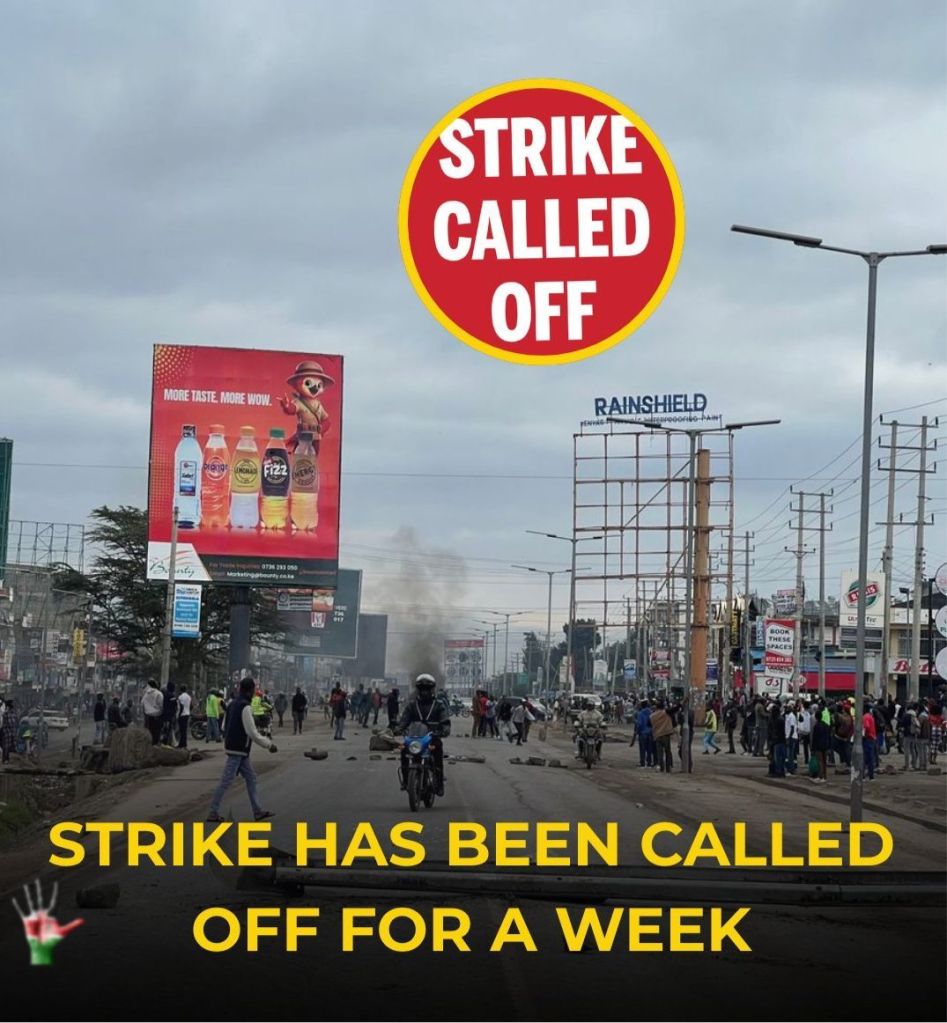
As I write this, Kenya is in the grip of a nationwide transport strike which has now been suspended for 7 days. Four people have been killed. Thirty have been injured. Matatu fares have surged to KSh 190 in Nairobi. Businesses are shuttered across the country. Factories are idle. Cargo sits rotting at the port and along our highways. The images of burning barricades on Thika Road and Mombasa Road are being broadcast on Bloomberg, the BBC, and Al Jazeera, denting our reputation as the stable, investable economy in East Africa.
The economic losses from a single week of this disruption — in man-hours, lost output, destroyed property, cancelled orders, postponed investments, and scared-off tourists — will dwarf the KSh 40 billion monthly cost of a meaningful fuel stabilisation programme. The arithmetic is not complicated. You cannot save KSh 40 billion by destroying KSh 200 billion in economic activity.
A government that claims it cannot find KSh 40 billion a month for fuel stabilisation is the same government that is spendthrift in ways that would embarrass a Fortune 500 CEO, and that continues to service commercial loans taken at punitive interest rates for various projects — and worst of all, the local borrowing that is busy elbowing out SMEs from the credit queue. The money exists. It is a question of priorities, and right now, the priorities are not right.
• • •
VI. The Kerosene Blunder: How to Destroy Your Own Forests
The decision to raise kerosene prices — or more accurately, to withdraw the subsidy that had been keeping them stable — deserves its own discussion because it represents a special kind of policy incoherence.
Kenya has spent decades and billions of shillings on forest conservation, tree planting campaigns, and climate commitments. We have set targets under the Paris Agreement. We have created institutions like the Kenya Forest Service. We routinely lecture the world about our commitment to a green future at every COP summit.
And then, in the middle of a fuel crisis, the government makes the one fuel that low-income households use for cooking — kerosene — unaffordable. What happens next is entirely predictable: those households do not switch to LPG, which has also become expensive thanks to the failed government domestic cooking gas project. They do not install solar cookers. They go back to charcoal. And charcoal means trees being cut down in Mau Forest, on Mt. Kenya, in the Cherangani Hills, in Bamba Magarini Kilifi, in Baringo — in every gazetted and ungazetted forest in this country.
The kerosene subsidy was not a luxury. It was the single cheapest forest conservation programme the government had.
Spending KSh 2–3 billion per month to keep kerosene affordable does more for Kenya’s tree cover than every reforestation campaign combined. Destroying this subsidy to save a few billion shillings while simultaneously spending billions on tree planting ceremonies is the kind of policy contradiction that makes development partners, climate funders, and ordinary Kenyans question whether anyone in Nairobi is reading the whole playbook or just the page that suits them.
• • •
VII. What the Government Should Do — Starting This Week
Kenya is in survival mode. This is not the time for textbook economics, IMF orthodoxy, or political calculations about the next election. When your house is on fire, you do not argue about the water bill. Here is a practical, immediate set of interventions:
1Restore and Protect the Kerosene Subsidy Fully
This is non-negotiable. Kerosene is a survival fuel for millions of Kenyans and the cheapest insurance policy for our forests. The subsidy should be funded from the Petroleum Development Levy Fund and, if necessary, from the Equalisation Fund. The recent increase to KSh 191.38 must be reversed immediately.
2Suspend the Road Maintenance Levy for 90 Days
The Road Maintenance Levy accounts for KSh 25 per litre. Suspending it for 90 days would immediately cut pump prices by KSh 25 — roughly a 10–12% reduction. Our roads will not collapse in 90 days. And frankly, given the state of our roads despite collecting this levy for years, Kenyans are entitled to ask what value they have been getting.
3Reduce or Suspend Excise Duty on Diesel
Diesel is the fuel of the Kenyan economy. It moves our food, our goods, our people. At KSh 242.92, it is choking every productive sector. Suspending excise duty on diesel (KSh 11.37 per litre) for the duration of the Hormuz crisis would provide immediate relief to transporters, farmers, and manufacturers. The revenue loss is manageable compared to the economic destruction the current prices are causing.
4Cut Government Spending. Seriously and Visibly.
If the government needs to find KSh 30–40 billion monthly for fuel stabilisation, there is a clear menu of options. Freeze all new government vehicle purchases until the crisis passes. Suspend all non-essential capital projects for six months. Renegotiate or suspend the G-to-G fuel import arrangement.
These are not radical measures. They are what responsible governments do in a crisis and they send a powerful signal to Kenyans that the sacrifice is shared — that the leaders who ask mwananchi to endure KSh 243 diesel are not themselves riding in fuel-guzzling V8s bought with public money.
5Diversify Fuel Supply Sources Immediately
The G-to-G arrangement concentrated our fuel imports with Gulf suppliers who are now directly affected by the Hormuz closure. Kenya should immediately diversify to suppliers from West Africa, the Americas, and Indian refineries. Ethiopia, despite being landlocked and poorer, has already signed an emergency supply deal with Vitol for fuel on 360-day credit terms. If Addis Ababa can show that kind of commercial agility, Nairobi has no excuse.
6Build the Strategic Petroleum Reserve — No More ‘Discussions’
The Petroleum Act of 2019 envisaged a strategic petroleum reserve. Seven years later, we have nothing built. Japan holds 260 days of supply. South Korea holds 210 days. India holds 25 days. Kenya holds zero. The government must stop “discussing” this and start building it. Even a modest 30-day reserve at Mombasa would have insulated us from the worst of this crisis. Every month without a reserve is a month we are gambling with the economy.
• • •
VIII. A Message to Fellow Kenyans
We must be fair-minded even in our anger. The government did not cause the war in the Middle East. It did not close the Strait of Hormuz. It did not set global crude prices. The current crisis is a genuine external shock that has affected every oil-importing country on earth.
But we are uniquely vulnerable — and that vulnerability is not an accident of geography. It is the result of choices our leaders have made over decades: the failure to build a strategic reserve despite the law requiring one since 2019, the failure to develop any domestic refining capacity, the progressive overloading of fuel with taxes and levies to plug budget gaps, the premature abandonment of subsidies under IMF pressure without adequate alternatives for ordinary Kenyans, and the concentration of imports through a scandal-plagued G-to-G arrangement that enriched middlemen while leaving the country exposed.
When someone tells you “the government cannot afford a subsidy,” ask them this: can the government afford a collapsed economy? Can it afford a nation on strike, with people dying in the streets? Can it afford the inflation spiral that KSh 243 diesel will trigger across food, transport, electricity, and manufacturing? Can it afford losing its hard-won position as East Africa’s most stable and investable economy — while landlocked Ethiopia, with a quarter of our per capita income, manages to sell diesel at less than half our price?
The answer is no. A KSh 40 billion monthly intervention, funded by temporary tax suspensions and genuine budget cuts at the top, is a bargain compared to the alternative. The money is there. What is missing is the political courage to redirect it, the humility to tell the IMF that survival comes before fiscal targets, and the honesty to admit that the current approach has failed.
• • •
IX. The Bottom Line
This crisis will pass. The Strait of Hormuz will eventually reopen. Oil prices will stabilise. But the structural vulnerabilities that this crisis has exposed — no strategic reserve, no refining capacity, excessive taxation of a survival commodity, policy incoherence between energy pricing and environmental conservation, and a government that moves too slowly when its people are suffering — these will remain until we fix them.
To the government: the people elected you to lead, not to recite IMF talking points while your neighbours outperform you. Ethiopia is landlocked, poorer, and recovering from civil war, yet it is absorbing 272 billion Birr in fuel subsidies because it understands the stakes. Tanzania has a port just like ours and manages to sell fuel cheaper. Uganda is landlocked and still cheaper. What is your excuse? Lead. Cut your budgets. Share the sacrifice. Protect the vulnerable. Build the reserve. Diversify the supply chain. And for the love of this country, put the kerosene subsidy back.
To my fellow Kenyans: demand better, but also understand the full picture. The problem is not one person or one party. It is a system built over decades that left us exposed to exactly this kind of shock. Fixing it will take more than one pricing cycle. But we must start now, because the next crisis is not a matter of if, but when.
The question is not whether we can afford to act.
The question is whether we can afford not to.
Mohammed Hersi
Mr Optimist
Mombasa
Sources: All figures cited in this article are drawn from EPRA pricing reviews (Kenya), EWURA cap prices (Tanzania), Ethiopia Ministry of Trade announcements, Capital Ethiopia reporting on subsidy figures, GlobalPetrolPrices data, IMF Spring Meetings reports (April 2026), IEA Oil Market Report (May 2026), Africa Check fact-checks, Bretton Woods Project research, and publicly available parliamentary records. Exchange rate conversions use mid-market rates as of May 19, 2026 (1 ETB ≈ KSh 0.83; 1 TZS ≈ KSh 0.05). I welcome corrections and constructive engagement.


 Mohammed Hersi . A hotelier passionate about Tourism & Governance in Africa
Leave a comment