By Mohammed Hersi
There is a quiet disease that kills more businesses than competition, recession or bad luck. It does not show up in the balance sheet until it is too late. It is the disease of the comfortable leader, the one who has filled the boardroom with nodding heads and the management team with people who will never tell him he is wrong.
I have watched it happen across three decades in hospitality and tourism. Hotels with prime beachfront and generous budgets slowly bleeding out, while smaller properties with half the resources outperformed them year after year. The difference was rarely the product. It was almost always the people sitting around the leader’s table.
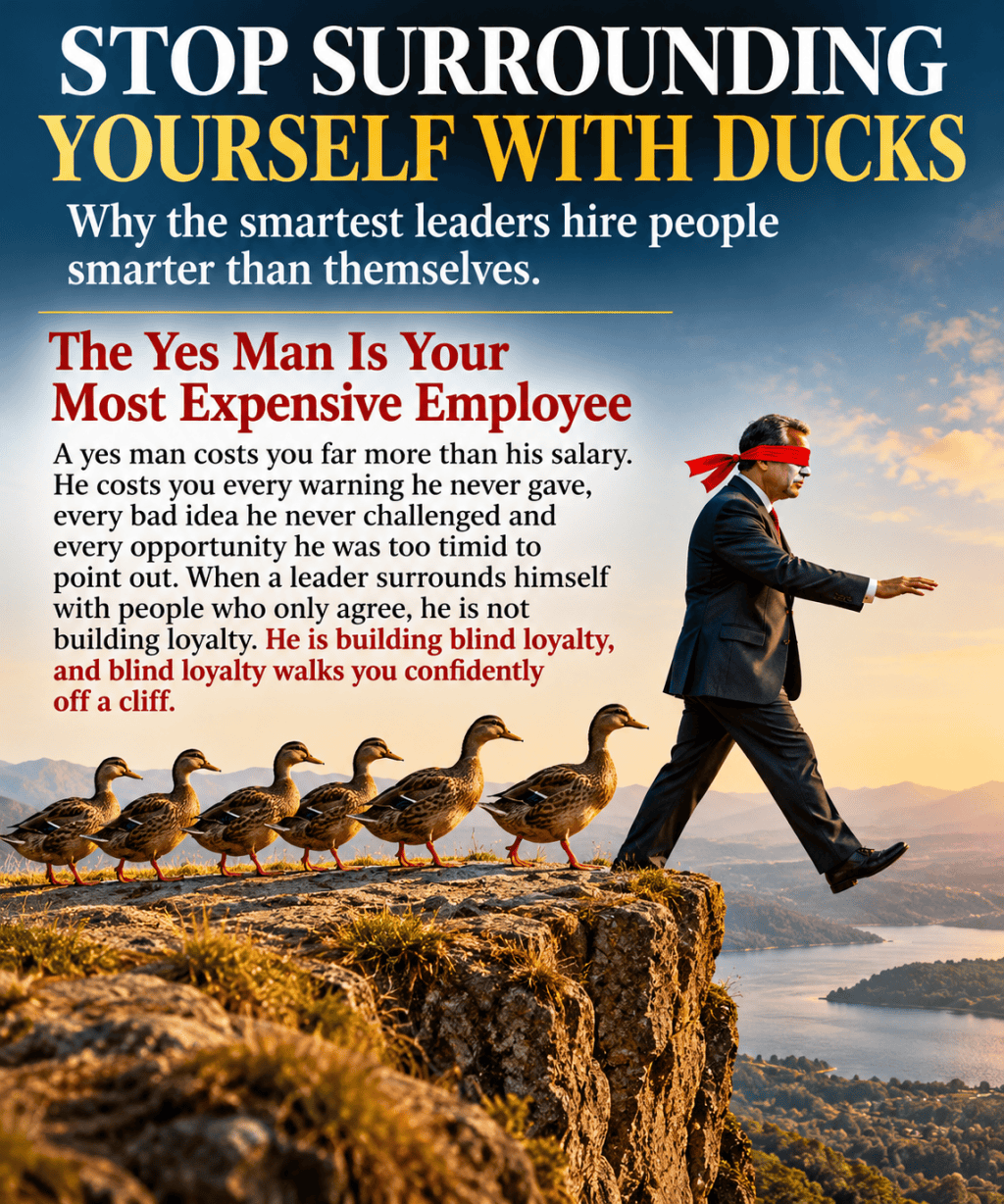
The Yes Man Is Your Most Expensive Employee. A yes man costs you far more than his salary. He costs you every warning he never gave, every bad idea he never challenged and every opportunity he was too timid to point out. When a leader surrounds himself with people who only agree, he is not building loyalty. He is building blind loyalty, and blind loyalty walks you confidently off a cliff.
Alfred P. Sloan, the legendary head of General Motors, understood this. At the end of one meeting where everyone agreed with a proposal, he reportedly suggested postponing the decision so the team could take time to develop some disagreement and properly understand what they were deciding. Sloan knew that unanimous agreement is usually a sign that nobody is thinking.
Agreement feels good. It massages the ego. But comfort is the enemy of growth, and a leader who needs constant validation has already stopped leading.
Hire Giants, Not Dwarfs David Ogilvy, the father of modern advertising, put it best: “If each of us hires people who are smaller than we are, we shall become a company of dwarfs. But if each of us hires people who are bigger than we are, we shall become a company of giants.” This is the test of a secure leader. Insecure leaders hire people they can control. Secure leaders hire people who can outthink them. The insecure leader fears the brilliant revenue manager who might expose his outdated pricing strategy. The secure leader hires that revenue manager, gives her the keys and watches occupancy and rate climb together.
Steve Jobs said it plainly: it makes no sense to hire smart people and then tell them what to do. You hire smart people so they can tell you what to do. Andrew Carnegie, one of the richest men in history, was said to have wanted his epitaph to read: “Here lies a man who knew how to enlist in his service better men than himself.” Carnegie did not know everything about steel. He did not need to. He knew how to find the people who did.
You Are the Average of Your Circle
Jim Rohn famously said that you are the average of the five people you spend the most time with. Look carefully at your inner circle. Your management team. Your board. Your friends and confidants. Are they stretching you or shrinking you? Are they pushing you toward excellence or keeping you comfortable in mediocrity?
John C. Maxwell calls this the Law of the Inner Circle: a leader’s potential is determined by those closest to him. No leader rises above the quality of the people he keeps close. You can have vision, capital and ambition, but if your inner circle is average, your results will be average. Every single time.
Don’t Surround Yourself With Ducks and Wonder Why You Can’t Fly
Here is the hard truth. If you surround yourself with ducks, do not be surprised that you are not flying. Ducks waddle. Ducks quack. Ducks paddle around the same pond all day and call it progress. Eagles soar, but eagles do not fly with ducks.
Too many business owners complain that their companies are not growing. They blame the economy, the government, the competition and the market. Yet when you look at who they have hired and who they listen to, the answer is staring them in the face. They have built a pond full of ducks and they are wondering why nobody is reaching the sky.
Mediocrity is contagious. When average performance is tolerated, it becomes the standard. When the best people in the room are never challenged, they leave. And when the leader is the smartest person in the room, the room is too small for the business to grow.
There is an old saying worth repeating to every founder and every CEO: if you are the smartest person in the room, you are in the wrong room.
What Great Leaders Do Differently
Great leaders do four things consistently.
✅️1. They hire for strength, not comfort. They look for people who know more than they do in finance, technology, sales, operations and guest experience, and they are not threatened by it.
✅️2. They reward honest disagreement. The person who tells the CEO the uncomfortable truth in the meeting is worth ten people who whisper it in the corridor afterwards.
✅️3. They audit their inner circle. They regularly ask: who in my life is making me better, and who is merely making me comfortable?
✅️4. They put the mission above their ego. They understand that the goal is not to be the hero of every meeting. The goal is to build an organisation that wins.
No leader, however gifted, builds anything great alone. And the African proverb reminds us that if you want to go fast, go alone, but if you want to go far, go together. I would add one thing: make sure you are going together with eagles. The Choice Is Yours.
Every leader eventually faces a simple choice. You can be the biggest fish in a small pond, surrounded by people who applaud everything you say. Or you can humble yourself, bring in people who are sharper, bolder and smarter than you, and build something that outlives you.
The first path feels safe. The second path builds legacies.
Choose your circle carefully. Hire giants. Reward courage and stop surrounding yourself with ducks because eagles do not fly with ducks, and neither should you.


Leave a Reply